AI Token Pricing War: What You Actually Get From OpenAI, Anthropic, Meta, Google and Grok
- Jul 11
- 9 min read

The largest AI labs are shipping new models faster than most companies can properly evaluate them. This comparison looks at what major providers, OpenAI, Anthropic, Meta, Google, and Grok, actually charge for input and output tokens. It also shows where lower token rates do, and don't, translate into lower real-world cost.
OpenAI released the GPT-5.6 family. Anthropic launched Claude Sonnet 5. Meta introduced Muse Spark 1.1 and its commercial Model API. Google upgraded its workhorse model to Gemini 3.5 Flash. Grok 4.5 arrived with a heavy focus on coding, agents and technical work.
Every release comes with new benchmark claims, longer context windows and a different argument for why its tokens provide the best value. For developers, product teams and organizations choosing models for professional, technical or other high-stakes work, price only becomes useful when it is compared alongside capability, context size, latency, benchmark performance and the odds that the model completes the task correctly.
But tokens are not commodities yet.
A million tokens from one model will not necessarily produce the same amount of text, complete the same task or cost the same once reasoning, tools and retries are included. The cheapest model per token can become expensive if it takes several attempts to finish the job. The most expensive model can be economical if it gets a difficult task right the first time. That is why this comparison looks beyond token tables to the hidden operational costs, task success rates and trustworthiness that determine actual value in decision-critical use cases.
So what are companies actually paying for?
The current token market
API providers generally use token based pricing, with token pricing and API pricing set through per token pricing for input tokens. That’s the information sent to the model, and output tokens: the text and reasoning generated by it.
Here is how LLM API pricing compares across providers, and how current LLM pricing differs for each large language model class when teams evaluate AI models for the same model or the same task:

Pricing and model information checked July 10, 2026.
*The sample workload assumes 100,000 input tokens and 20,000 output tokens. It excludes caching, batch discounts, tool calls, search charges and other platform-specific fees.
Output tokens require significantly more computational power than input tokens, which helps explain why output token pricing is usually higher.
For that workload, Meta is the least expensive at approximately $0.21. OpenAI’s premium Sol model costs $1.10. More than five times as much.
That does not automatically make Meta the best value or OpenAI the worst. Price per token only becomes meaningful when paired with task completion, output length, latency and accuracy, because buyers need to weigh input cost against response quality and output token pricing to estimate the total cost.
OpenAI: The premium models option, with less expensive models in the same family
GPT-5.6 is divided into three tiers, and OpenAI API pricing also varies across generations, with earlier comparison points such as gpt 5.2 helping frame how LLM API pricing shifts over time:
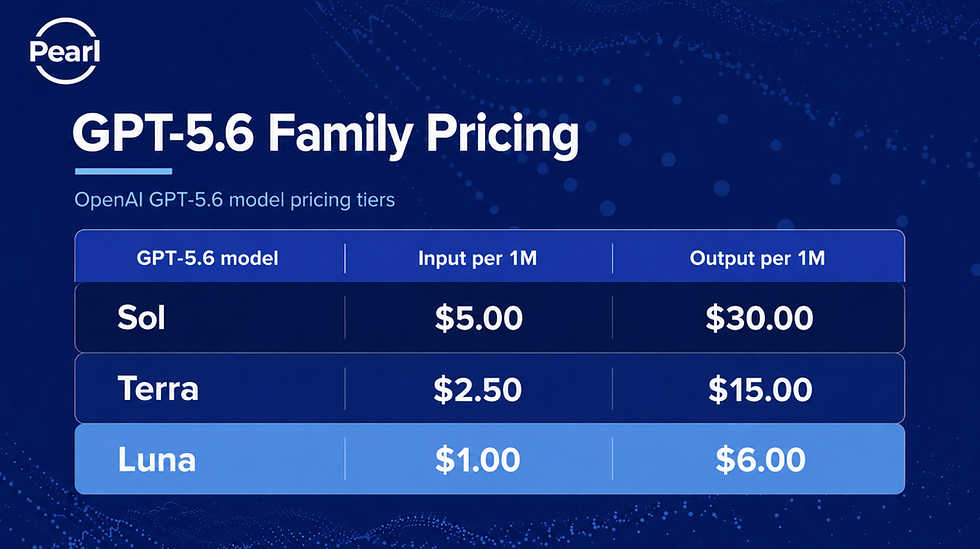
Sol is the flagship model for complex professional work. Terra is positioned as the middle ground, while Luna is designed for cost-sensitive, high-volume workloads. All three models support a 1.05-million-token context window, up to 128,000 output tokens, text and image inputs, reasoning, structured outputs and tools such as web search, file search, code execution, computer use and MCP. (OpenAI)
On the Artificial Analysis Intelligence Index, GPT-5.6 Sol scored 59 at maximum reasoning effort. Terra scored 55 and Luna scored 51. Sol also led the organization’s Coding Agent Index with a score of 80. (Artificial Analysis)
Among the five headline models in this comparison, Sol currently has the highest independent Intelligence Index score. It is also the most expensive.
Lower-cost OpenAI reference points include gpt 4o and gpt 4o mini, with GPT-4o Mini priced at $0.15 per million input tokens.
OpenAI's GPT-5.2 costs $1.75 per million input tokens and $14 per million output tokens, which shows how newer releases can reset token pricing over time.
There is another cost to watch. OpenAI charges twice the normal input rate and 1.5 times the output rate for the entire request when a prompt exceeds 272,000 input tokens. Cache writes are also billed at 1.25 times the standard input rate. (OpenAI Developers)
For difficult professional work, Sol may justify its premium. For high-volume classification, extraction or support tasks, Terra or Luna could make more economic sense, and different models in the same provider lineup are often chosen to match quality requirements, with GPT-4o Mini serving as one of the budget models and Sol sitting with the premium models.
Anthropic: Frontier-level performance at a temporary discount
Claude Sonnet 5 launched at an introductory rate of $2 per million input tokens and $10 per million output tokens. That rate lasts through August 31, 2026. On September 1, standard pricing is scheduled to increase to $3 for input and $15 for output. (Anthropic)
Sonnet 5 includes a one-million-token context window, a standard maximum output of 128,000 tokens, image input, adaptive reasoning and support for agentic workflows involving browsers, terminals and other tools. Anthropic positions it as a faster, less expensive alternative, while Claude Opus 4.6 costs $5.00 per million input tokens and remains a higher-capability comparison point for some enterprise use cases. (Claude Platform)
Artificial Analysis gave Sonnet 5 a score of 53 at maximum reasoning effort. It generated output at approximately 81 tokens per second in that evaluation, but it was also considerably more verbose than the typical model tested. (Artificial Analysis)
That verbosity matters because longer responses raise real costs by increasing token usage in text generation workloads.
Anthropic also introduced a new tokenizer with Sonnet 5. According to its documentation, the same text can produce approximately 30% more tokens than it did with Sonnet 4.6. The exact increase depends on the content, but it means teams should not assume that an unchanged or discounted per-token rate will translate directly into an equivalent per-task cost. (Claude Platform Docs)
Sonnet 5’s introductory pricing makes it highly competitive today. Buyers should still model what their costs will look like after the promotional rate expires, and those comparing it with claude opus 4.6 should weigh superior capabilities against higher cost where relevant.
Meta: The lowest sample cost in this comparison
Muse Spark 1.1 is Meta’s new commercial model for coding, computer use, multimodal reasoning and agentic work.
The Model API starts at $1.25 per million input tokens and $4.25 per million output tokens. Muse Spark 1.1 can actively manage a one-million-token context window and is designed to operate as either the main agent coordinating a task or a subagent completing a delegated portion of it. (Developer Meta)
At these rates, it produces the lowest cost for the sample workload in this article.
Meta’s evaluation report also shows strong results on several agent and tool-use benchmarks:

Meta’s results put Muse Spark 1.1 ahead of the comparison models on MCP Atlas and close to the leaders on several agentic tests. It trailed Claude Opus 4.8 and GPT-5.5 on some coding benchmarks, including Terminal-Bench and SWE-Bench Pro.
Those numbers require an important qualification. Meta’s table combines results from its own API evaluations, official leaderboards, third-party providers and other labs’ self-reported scores. The models and harnesses are not identical across every test.
Muse Spark 1.1 does not yet have a directly comparable Artificial Analysis Intelligence Index score in the sources reviewed. Its early numbers are promising, but companies should test it against their own tasks before treating Meta’s benchmark table as a universal ranking.
Google: The broadest mix of native inputs and tools
Google’s API pricing spans multiple Gemini models, including gemini 2.5 pro, gemini 2.5 flash, gemini flash, and gemini 3.1 pro as useful comparison points within the same ecosystem, while Gemini 3.5 Flash costs $1.50 per million input tokens and $9 per million output tokens at standard rates.
Google also offers Batch and Flex processing at $0.75 for input and $4.50 for output, cutting token costs in half for workloads that do not require standard real-time processing. (Google AI for Developers)
Google's Gemini 2.5 Pro charges $1.25 per million input tokens and $10 per million output tokens. Google's Gemini 3.1 Pro costs $2 per million input tokens.
Gemini 3.5 Flash accepts text, images, video, audio and PDFs, with text as its output. It supports an input limit of 1,048,576 tokens and an output limit of 65,536 tokens. Its tools include code execution, computer use in preview, file search, function calling, structured outputs, Google Search grounding, Maps grounding and URL context. Models processing images or video require exponentially more compute than text, which is part of why multimodal pricing differs. (Google AI for Developers)
That makes Google particularly attractive for workflows involving several media types. A team processing recorded calls, PDFs, screenshots, videos and web information may be able to keep more of the workflow inside one model ecosystem.
Gemini 3.5 Flash scored 50 on the Artificial Analysis Intelligence Index at high reasoning effort. Artificial Analysis also measured it at approximately 161 output tokens per second, making it notably faster than the average model in its comparison group. (Artificial Analysis)
Gemini may not have the highest general intelligence score here, but its combination of speed, multimodal input, long context and discounted asynchronous processing gives it a strong operational case. Gemini 2.5 Flash costs $0.30 per million output tokens and can be useful for volume-oriented or cheap models routing.
Grok 4.5: Competitive intelligence with a lower output price
Grok 4.5 costs $2 per million input tokens and $6 per million output tokens and supports a 500,000-token context window.
It offers configurable low, medium and high reasoning levels, along with function calling, web search, X search and code execution. The model is positioned around coding, agentic tasks and knowledge work. (SpaceXAI Docs)
The output rate is one of Grok’s clearest advantages. It is lower than Anthropic, Google and OpenAI Sol, which can matter in coding and agent workflows that generate large amounts of reasoning or code.
Grok 4.5 scored 54 on the Artificial Analysis Intelligence Index—one point above Claude Sonnet 5 and four points above Gemini 3.5 Flash. Artificial Analysis measured its output speed at approximately 90 tokens per second. (Artificial Analysis)
In Grok’s published results, the model scored 83.3 on Terminal-Bench 2.1 and 64.7 on SWE-Bench Pro. That put it nearly even with GPT-5.5 on Terminal-Bench and ahead of it on SWE-Bench Pro, although these comparisons combine results from published system cards and benchmark leaderboards. (SpaceXAI)
Grok also offers real-time web and X search, but those tools carry separate usage fees. Web search, X search and code execution are each priced at $5 per 1,000 calls. (SpaceXAI Docs)
For technical workflows with substantial output, Grok’s combination of competitive benchmark performance and a $6 output rate is compelling.
So which model provides the best value?
There is no universal winner.
OpenAI GPT-5.6 Sol has the highest independent Intelligence Index score among the five models compared, but it also has the highest token price.
Claude Sonnet 5 offers strong frontier performance at a lower introductory rate, although its tokenizer and tendency toward longer outputs can change the real cost.
Muse Spark 1.1 has the lowest sample cost and strong vendor-reported agentic results, but it has less independent evaluation data available.
Gemini 3.5 Flash combines high speed with the widest selection of native input types and Google tools.
Grok 4.5 sits close to the frontier on independent testing while maintaining a comparatively low output price.
The more useful metric is not price per million tokens. Cost optimization starts after that baseline, as teams optimize costs against actual task success. It is cost per successfully completed task.
That calculation should include:
How many attempts the model needs, especially across different models in a proof of concept
How much reasoning and output it generates, including prompt length under tiered pricing and hybrid pricing
Whether it requires search or other paid tools, and how those affect api usage
How often repeated queries create savings through cached tokens or other caching
Whether a batch api discount applies and how often a human must correct the result
What happens when an incorrect result reaches the user, and whether cost predictability matters more than the lowest sticker price
Smart routing can reduce costs by 40-60%, and teams that mix models across cheap models, mid-tier models, and reasoning models in a model cascade often cut costs enough to save 60-80% overall.
A 50% reduction in prompt length equals 50% savings, and setting maximum response lengths can significantly reduce costs.
Caching can save up to 90% on repeated tokens, and prompt caching can cut costs by 50x to 120x for repeated prompts.
A model that costs half as much but needs three attempts is not cheaper. A model that performs well on a public benchmark but fails on your internal data is not more capable. Larger models also require more GPU infrastructure to run, so premium pricing can reflect more than benchmark quality alone. And a model that generates the right answer 95% of the time may still be unsuitable when the remaining 5% can cause real harm.
DeepSeek is often cited as the cheapest llm api on raw token pricing, with input tokens starting at $0.28 per million, but the best value still depends on the task. Adoption metrics should include active users and AI workload processed, not just price comparisons.
Output token pricing tells you what it costs to generate an answer
It does not tell you what it costs to trust one.
That distinction matters in high-stakes fields such as law, medicine, finance and pet health, where an incorrect answer can create consequences far beyond the price of an API call.
A model can generate a legal explanation in seconds, but that does not guarantee every citation is real.
It can recommend a possible medical next step, but that does not mean the recommendation is appropriate for a specific patient.
It can produce a confident answer at a lower price, but confidence is not verification.
Benchmarks help measure model performance under specific testing conditions. They cannot replace judgment, accountability or the ability to escalate a question when the stakes are real.
That is what most token-price comparisons leave out.
OpenAI, Anthropic, Meta, Google and Grok are competing to make intelligence faster, more capable and less expensive.
Pearl helps make that intelligence safer to act on by connecting AI workflows with credentialed human experts who can review, correct or confirm an answer and step directly into the conversation when more context is needed.
Because in a high-stakes decision, the most important question is not how little the answer cost to generate.
It is whether you can trust what happens next.


Comments