Free Veterinary AI Whitepaper: The Divergence of Veterinary and Consumer AI Use
- Jun 11
- 14 min read
The same artificial intelligence that helps a clinic write discharge summaries can quietly steer a pet owner toward an incorrect home treatment before an appointment even happens. The difference is not the AI. The difference is who verifies the output.
A new free veterinary ai whitepaper titled "The Divergence of Veterinary and Consumer AI Use: Clinical Integration vs. Public Misinformation Risk" examines exactly this split-and what it means for clinics right now.
Key Takeaways
The same artificial intelligence model can produce safe outcomes in a clinic and risky outcomes at home. The variable is a verification gap between supervised veterinary use and unsupervised consumer use.
The free veterinary AI whitepaper, "The Divergence of Veterinary and Consumer AI Use: Clinical Integration vs. Public Misinformation Risk," is available for immediate download at no cost.
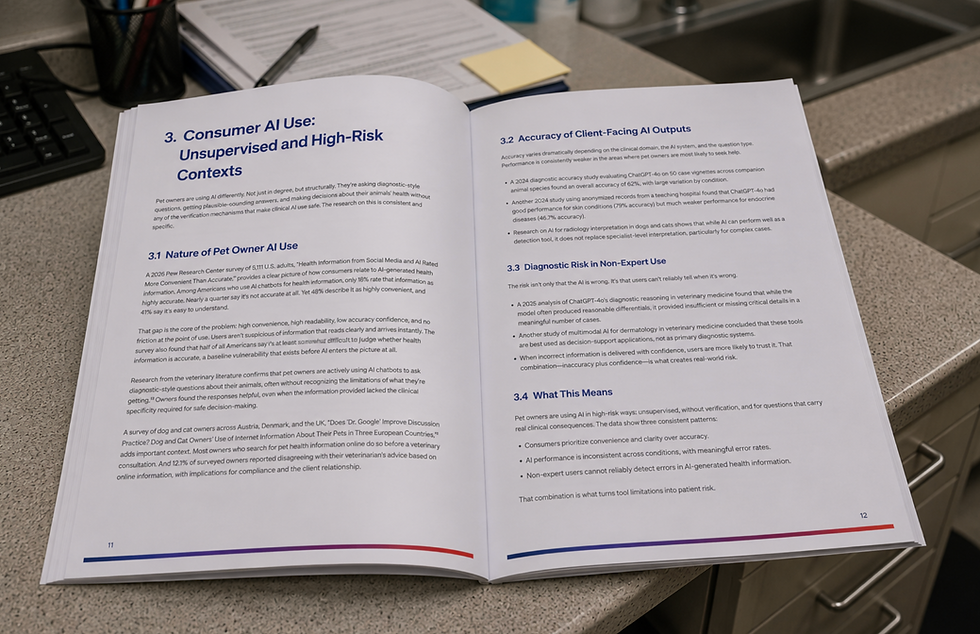
Veterinary ai is used inside clinics for structured, low-risk tasks like documentation, scheduling, and client communication-always with clinician oversight. Pet owners often use general ai tools such as ChatGPT before a vet visit, without any professional verification.
The white paper maps credible risk pathways including delayed care, dosing mistakes, misinterpretation of symptoms, and disagreement with veterinary advice. It does not claim proven animal harm.
This article covers ai in veterinary medicine, ethical considerations, client communication challenges, and practical steps clinics can take today to respond to AI-shaped client behavior.

Why This Free Veterinary AI Whitepaper Matters Right Now
Pet owners are already using general-purpose artificial intelligence systems for pet health questions. They ask about symptoms, medications, diets, and whether a trip to the veterinarian is necessary. Many of these interactions happen before they ever pick up the phone to call your clinic.
This matters because the answers they receive often sound polished, confident, and clinical-even when they are incomplete, out of context, or flat-out wrong.
The whitepaper focuses on a specific problem: the same AI model behaves differently depending on who uses it and whether any verification exists. Inside a veterinary practice, AI assistance is embedded in structured clinical workflows with human oversight. At home, the same type of large language models delivers answers with no accountability, no error detection, and no second opinion.
The core concept of this report is the verification gap. The issue is not whether AI is capable. The issue is that on the consumer side, there is no one performing security verification on the output. No clinician checks it. No medical record catches the error. No professional judgment filters the response.
Download the free whitepaper now. See the full research behind the verification gap and how it is already affecting veterinary care before appointments begin.
This document is built for veterinarians, practice managers, and clinical leaders working in general practice who need a clear, grounded analysis-not hype-of what is happening with AI and their clients.
Veterinary AI Use: Structured, Supervised, and Clinically Integrated
Inside veterinary clinics, artificial intelligence in veterinary medicine is already being adopted. But the way it is used looks very different from what pet owners do at home.
Veterinary professionals use AI for low-risk, supervised tasks that support-never replace-clinical decision making.
These tasks include:
Documentation and soap notes: Drafting visit summaries, discharge notes, and medical records entries for clinician review.
Scheduling and administrative support: Automating appointment management and internal workflows.
Client communication drafts: Generating follow-up messages, reminders, and care instructions that clinicians review before sending.
Data extraction: Pulling relevant information from patient histories to support decision-making.
Triage support notes: Assisting with preliminary intake documentation for clinical review.
In each of these clinical workflows, the process follows a consistent pattern: AI generates a draft, a trained clinician reviews it, edits as needed, and approves the final version. Only after this security verification step does the output enter the medical records or reach the client. When that verification is successful, the output becomes part of an accountable clinical process.
This is the framework described in the whitepaper. Veterinary AI is not used for unsupervised diagnostic decisions. It does not generate stand-alone treatment recommendations without a clinician in the loop. It does not interpret diagnostic images or deliver differential diagnoses without professional oversight.
The distinction matters because it defines what clinical safety looks like when new technologies enter veterinary practice. AI is a tool inside a system of accountability-not a replacement for clinical judgment.
Consumer AI Use: Pet Owners Asking General AI Tools for Medical Advice
On the other side of the verification gap, pet owners are using general-purpose ai technologies-including generative ai chatbots-to ask questions about their animals.
These are the kinds of prompts happening right now:
"Why is my dog vomiting-should I take them to the vet?"
"What dose of Benadryl can I give my cat?"
"My rabbit stopped eating. What should I do at home?"
"Is this lump on my dog something to worry about?"
These interactions typically happen before a veterinary visit. The behavior pattern is clear: the pet owner notices something concerning, types a question into a chatbot, and receives an answer that shapes their expectations, urgency level, and beliefs about what is wrong.
The problem is not that owners are curious. The problem is that responses from large language models can sound confident and authoritative while being incomplete, missing key context, or clinically inappropriate. A comparative analysis by Vetster found that AI-generated answers to common pet health questions often omitted important risk flags, failed to suggest urgent veterinary care, and presented narrow explanations without acknowledging alternative differential diagnoses.
Most pet owners are not equipped to critically evaluate dosing guidance, assess whether a suggested home treatment is appropriate for their specific animal, or detect subtle errors in symptom interpretation. They lack access to the animal's full history, lab results, or examination findings that a veterinarian would use.
The whitepaper does not blame pet owners for this behavior. It documents how unsupervised consumer use of AI creates conditions where misinformation can quietly accumulate-shaping decisions about animal health before a veterinarian is ever consulted.
The Verification Gap: Why the Same AI Behaves So Differently
The verification gap is the central concept of this whitepaper. It describes a straightforward problem:
When a veterinarian uses AI, the output is checked. When a pet owner uses the same type of AI, the output is accepted at face value.
This gap exists even when the underlying artificial intelligence model is identical. The difference is not the technology. The difference is the context of use:
Factor | Veterinary Clinical Use | Consumer Pet Owner Use |
Oversight | Trained clinician reviews all output | No professional review |
Accountability | Veterinarian bears responsibility | No clear accountability |
Error detection | Built into clinical workflows | No mechanism to catch errors |
Verification | Output checked before use in patient care | Output often accepted without question |
Escalation | Clinician can escalate or discard output | No structured path to veterinary care |
In human medicine, similar concerns have emerged around consumer use of AI for health decisions. The veterinary profession faces a parallel challenge, with the added complexity that animals cannot self-report symptoms or contradictions in the advice they receive.
The whitepaper frames this not as a binary question of "good AI" versus "bad AI." It frames it as a gap in validation, data transparency, and escalation. The same tool that achieves high accuracy when used inside a supervised clinical system may produce unreliable results in unsupervised real world use-not because it failed, but because no one was there to verify.
Think of it this way: performing security verification on AI output is what transforms a raw prediction into a clinical decision. Without that step, the output is unvalidated information-no matter how confident it sounds.
Download the free veterinary AI whitepaper to see the full analysis of the verification gap, including how it maps to specific risk pathways affecting your practice.
Pathways of Risk: How AI Misinformation Can Affect Veterinary Care
The whitepaper describes credible mechanisms of harm-risk pathways that are plausible and concerning, not proven or measured instances of animal harm. This distinction is important. The report intentionally avoids claiming documented harm events while making clear that these pathways deserve attention.
Here are the specific risk pathways the whitepaper identifies:
Delayed care
A pet owner receives a reassuring AI response suggesting a wait-and-see approach. They delay calling the clinic. Conditions that require prompt veterinary care-such as toxin ingestion, urinary obstruction, or GI foreign bodies-can worsen rapidly during that delay.
Incorrect home treatment
AI suggests wound care, dietary changes, or home remedies that may sound reasonable but are not appropriate for the specific animal, species, or condition. Without knowledge of the pet's full medical history, training data limitations in the AI model may lead to generic treatment recommendations that miss contraindications.
Dosing or medication errors
When pet owners rely on AI output for drug names, dosing frequency, or amounts, there is no professional oversight to catch species-specific differences, weight-based calculations, or drug interactions. This is a pathway where even small errors could create real harm to animal healthcare.
Misinterpretation of symptoms
AI-generated explanations may cause owners to minimize urgent clinical signs or overinterpret benign ones. A confident explanation that "this is probably nothing" can delay a visit. A dramatic explanation of a minor symptom can create unnecessary anxiety and misallocated urgency.
False confidence in incorrect self-diagnoses
When an AI tool delivers a polished, specific-sounding answer, pet owners may arrive at the clinic believing they already know what is wrong. This can set up direct disagreement with veterinary advice, especially when the veterinarian's assessment differs from what the AI suggested.
Disagreement with treatment plans
This pathway affects compliance. Owners who have formed expectations based on AI answers may resist recommended diagnostics, question treatment plans, or push for alternatives that match the AI's suggestion rather than the clinician's professional judgment.
Each of these pathways is described in the whitepaper as hypothetical but plausible. The mechanisms are credible. The whitepaper maps them carefully without overstating what has been proven.
Clinical Impact Today: Before the Appointment Even Starts
This is not a distant future scenario. It is happening in clinics today.
Much of the impact of AI misinformation on veterinary care occurs before the pet is brought in. Pet owners who consult AI tools before calling the clinic arrive with pre-formed ideas about what is wrong, what treatment should look like, and whether the visit is even necessary. This affects how quickly owners seek animal care and what they expect from the appointment.
Here is what clinics are already encountering:
Increased friction during consultations. Owners who received confident AI answers may push back when the veterinarian's assessment differs. The conversation shifts from collaborative to adversarial.
Pressure to match AI-suggested plans. Some clients arrive asking specifically for tests or treatments that an AI tool recommended-treatments that may not be clinically indicated based on actual examination findings.
Reduced clinical trust. When a polished AI answer contradicts professional advice, some owners default to the source that felt easier to understand. This erodes the client-veterinarian relationship even when the veterinarian is correct.
Added communication burden. Staff spend more time explaining why the AI's suggestion may not apply, addressing misinformation, and rebuilding trust-time that could be spent on direct patient outcomes improvement.
These impacts affect compliance, effective communication, and overall patient care quality. The veterinary field is not just dealing with misinformation in the abstract-it is managing real world shifts in client behavior driven by unsupervised AI use.
See the full research. Download the free whitepaper for a systematic breakdown of how AI misinformation is affecting veterinarians and how to respond at the clinic level.
Ethical Considerations, Accountability, and Data Privacy
The verification gap raises significant ethical concerns that the whitepaper examines in focused detail.
Accountability in clinical settings
When ai systems are used inside a veterinary practice, the veterinarian remains accountable for clinical decisions. This is consistent with the veterinary-client-patient relationship and the expectations of veterinary state boards. AI may draft, suggest, or summarize-but the clinician owns the decision. This accountability structure is what makes veterinary AI use ethically defensible.
Absence of accountability in consumer use
On the consumer side, there is no parallel accountability. When a pet owner accepts an AI-generated answer about their animal's health, no professional has reviewed it. No one bears responsibility for errors. The AI system itself carries no liability, and the pet owner likely does not understand the limitations of the tool's training data, model development process, or veterinary datasets used (or not used) in its construction.
Informed consent and transparency
Ethical veterinary healthcare requires informed consent. When AI is used in a clinic-even for administrative tasks-there is a growing expectation that clients understand its role. The whitepaper suggests that transparency about how ai tools are used in documentation and client communication is an emerging ethical responsibility, consistent with guidance discussed in publications like those from the Ontario Veterinary College and front vet sci journals.
Data privacy and big data
Questions about data privacy are increasingly relevant as clinics adopt AI tools that may process patient records, owner information, and clinical data. Whether through cloud-based platforms or local systems, the handling of veterinary data raises questions about ownership, anonymization, and informed consent for data sharing. Security service protections and policies around how data moves between clinics and third-party AI developers are still evolving.
Algorithmic bias and fairness
Algorithmic bias is a documented concern in both human healthcare and veterinary contexts. AI tools trained primarily on data from dogs and cats may show reduced diagnostic accuracy for exotic species. Breed, age, and geographic biases in training data can produce uneven output quality, raising fairness questions about which animals benefit from AI-assisted care and which are underserved.
The whitepaper approaches these ethical considerations as reasons to differentiate AI use-not to prohibit it. Responsible use requires validation, transparency, and human oversight. Irresponsible use is what happens when those safeguards are absent.
Practical Steps for Clinics: Responding to AI-Shaped Client Behavior
The whitepaper positions AI-influenced client behavior as a problem to be managed, not a technology to be rejected. Here are framing suggestions drawn from the whitepaper's concepts.
Ask early
Consider building a simple question into your intake process: "Have you looked up your pet's symptoms online or used an AI tool before this visit?" This is not confrontational. It is a neutral starting point for client communication that gives your team context for the conversation ahead.
Explain your own AI use transparently
If your practice uses AI for documentation, scheduling, or communication drafts, be prepared to explain that these tools are supervised, verified, and not used for unsupervised clinical decisions. This distinguishes your practice's approach from what the client may have experienced at home. Effective communication on this point builds clinical trust rather than undermining it.
Develop consistent talking points
All team members-veterinarians, technicians, front desk staff-should be able to respond calmly when a client raises an AI-generated idea. Consistent language around the verification gap helps:
"AI can be a helpful starting point, but it doesn't have access to your pet's exam findings or medical history."
"We use AI for some administrative tasks here, but all clinical decisions are made by our veterinary team."
"The information you found may be generally accurate, but we need to critically evaluate it against what we're seeing in the exam today."
Don't dismiss or blame
The goal is not to make pet owners feel foolish for consulting AI. The goal is to redirect the conversation toward evidence-based veterinary medicine while respecting client autonomy. Traditional methods of building trust-listening, explaining, showing your reasoning-still apply. AI just adds a new variable to manage.
Use the whitepaper for team alignment
The document can serve as a discussion starter for internal meetings. Use it to align your team on how to talk about AI risks, how to describe the verification gap, and how to handle situations where AI-informed expectations conflict with clinical findings.
Get the full analysis. Download the free veterinary AI whitepaper for a structured examination of these communication challenges and practical framing tools.
Framing Solutions: Differentiated, Verified AI Use
The whitepaper does not argue for removing AI from veterinary or consumer settings. It argues for differentiating how artificial intelligence is used and presented, depending on the context and the stakes involved.
The solution framing rests on several principles:
Clinical tools should be validated. AI used inside veterinary practice should have documented performance data, known limitations, and integration into accountable clinical workflows. This is where predictive modeling, predictive analytics, and precision medicine applications in veterinary care must meet rigorous standards before being widely adopted.
Consumer tools should include transparency and labeling. General-purpose AI answering pet health questions should clearly state its limitations, flag high-risk topics, and include visible prompts steering users to escalate concerning situations to veterinary care.
Escalation pathways matter. Consumer ai systems should actively direct users toward professional consultation when questions involve symptoms, medications, dosing, or conditions that require examination. The absence of these escalation prompts is part of what makes the current landscape risky.
The goal is to narrow the verification gap. Not by restricting AI access, but by ensuring that high-risk uses are not left unverified. Where human intelligence and professional expertise can check AI output, they should. Where they cannot-as in unsupervised consumer use-the tools themselves need to communicate that limitation clearly.
This connects to broader discussions in biomedical research and human medicine about how emerging technologies should be deployed. The veterinary profession faces similar regulatory considerations, and the whitepaper's framework is designed to support that conversation with specificity rather than generalities.
Machine learning applications in veterinary education, disease surveillance, and disease outbreaks monitoring represent areas of future potential where AI can improve patient outcomes when properly validated. But the lesson from the verification gap applies across all of these domains: the value of AI depends on whether its outputs are verified before they influence animal health decisions.
See the full research. Download the report for a clinic-focused breakdown of how to frame AI solutions in your practice.
About the Free Veterinary AI Whitepaper and How to Use It
Full title: The Divergence of Veterinary and Consumer AI Use: Clinical Integration vs. Public Misinformation Risk.
This is a free veterinary AI whitepaper designed for veterinarians, practice owners, and clinical leaders who are already encountering AI-related questions from clients. It is not a vendor pitch. It does not promote specific tools. It does not provide legal advice.
\What the whitepaper covers
How veterinary AI is used in structured, supervised workflows
How pet owners use general AI tools for animal health questions
The verification gap between these two contexts
Credible risk pathways including delayed care, dosing errors, and client disagreement
Solution framing around validation, transparency, labeling, and escalation
How to use it
Internal training: Use it to ground team discussions about AI and client behavior in specific, documented concepts rather than vague concerns.
Staff talking points: Pull language from the verification gap framework to create consistent responses for client-facing situations.
Policy development: Use the framing to shape how your practice describes its own AI use in documentation, client communication, and intake processes.
Continuing education: The document touches on intelligence in veterinary medicine, respond ray id tracking concepts for ai systems, and regulatory considerations that are relevant to ongoing veterinary education discussions discussed in vet sci and vet med assoc publications.
The whitepaper stays within its stated scope. It maps credible mechanisms. It describes real world use patterns. It offers framing-not prescriptions.
Download the free whitepaper now. Get the full analysis and start using it in your practice this week. The verification gap is not closing on its own. Your clinic is already dealing with its effects. This document gives you a structured way to respond.
FAQ
Is this whitepaper about specific veterinary AI products or vendors?
No. The whitepaper focuses on patterns of use rather than endorsing or critiquing specific commercial products, vendors, or named AI tools. It examines how the same category of artificial intelligence systems produces different outcomes depending on whether the user is a supervised clinician or an unsupervised pet owner. It does not function as a product review, buyer's guide, or comparison of malicious bots versus legitimate clinical tools.
Does the whitepaper claim that AI has already caused animal harm?
No. The report does not document proven harm cases. It maps credible mechanisms and pathways through which AI misinformation could lead to delayed veterinary care, incorrect home treatment, dosing errors, or disagreement with clinical advice. These are described as plausible risk pathways, not measured outcomes. This distinction is maintained throughout the document.
How is this different from general articles on artificial intelligence in veterinary medicine?
Most general articles list broad benefits of AI or speculate about future potential. This whitepaper does neither. It focuses narrowly on the verification gap between supervised clinical use and unsupervised consumer use. It does not cover the full landscape of AI assistance or catalog every application of machine learning in animal care. It addresses a specific, present-day problem affecting how clients interact with clinics.
Who should download this free veterinary AI whitepaper?
It is intended for veterinarians, practice owners, medical directors, and team members in general practice who are seeing AI-informed questions and expectations from clients. It is also relevant to those involved in veterinary education, practice management, and clinical leadership who want a grounded framework for discussing AI's role in their organization.
Can I share or use the whitepaper for team training?
Yes. Practices can use the document as a discussion starter for internal meetings. It can help teams align on how to talk about AI risks, respond to client communication challenges related to AI-generated expectations, and develop consistent language around the verification gap. It is designed to be practical and shareable, not locked behind academic jargon or restrictive access.


Comments