How to Take Enterprise AI Deployment From Demo-Ready to Production-Ready
Imagine a customer disputing a charge with your AI chatbot. In the demo, the answer was flawless. In production, the system pulls stale policy data, misreads the customer's plan tier, and generates a response that contradicts your refund rules. The customer calls your support line. The agent spends twelve minutes unwinding the confusion. Enterprise AI deployment fails not because the model is bad, but because the workflow around it was never built for real conditions. This article breaks down the layers that separate a passing demo from a safe, governed, production-grade AI system, and explains where qualified expert review fits.

Why Enterprise AI Breaks at the Customer Edge
Here’s another example: a customer submits a complex auto insurance claim through your AI-powered portal. In staging, the pilot chatbot handled similar claims with 94% accuracy against a curated test set. In production, the customer's policy has a state-specific amendment from 2024, the claims database returns an incomplete vehicle history, and the user submits the query from a mobile device with a typo in the VIN. The chatbot returns a coverage determination that contradicts the amendment.
The demo environment had none of these conditions. It ran on static sample data, narrow prompts, cooperative "happy-path" questions, no jurisdictional constraints, and no real data privacy pressure. Every input was clean. Every output looked correct.
Production reality is different. Queries are ambiguous and records are incomplete. Policy documents conflict across regions and legacy systems return data in formats the model was not trained on. Users are stressed, on mobile, at odd hours. A 2026 study of enterprise AI adoption challenges identified data fragmentation and lineage gaps as top blockers for moving past the pilot stage.
The business consequence of getting this wrong: broken trust with policyholders, higher call volumes for support teams, abandoned digital claims, escalated complaints, and regulatory exposure. Yum! Brands experienced a version of this when its voice-AI drive-thru pilot mishandled orders in noisy environments, over-upsold, and frustrated customers. A Chevrolet dealership chatbot agreed to sell a vehicle for $1 after a user exploited the absence of guardrails.
The central thesis is direct: enterprise AI deployment must decide which artificial intelligence outputs can ship automatically and which need more context or expert review. Model accuracy alone does not answer this question.
A 30-Second View of Enterprise AI Deployment
Enterprise AI deployment means moving AI systems, including AI agents, from pilot to governed, integrated, monitored production across multiple workflows and regions. Enterprise AI means more than hosting a model. It includes infrastructure, data access patterns, security controls, AI governance, change management, escalation, and ongoing evaluation. AI deployment requires a structured plan for integration and governance.
Most failures now occur in deployment and operations: connecting AI tools to real data pipelines, enforcing policy at runtime, meeting data privacy requirements, and enabling support teams to handle exceptions. The deployment process itself is where enterprise AI solutions break down.
The potential is real. Generative AI boosts productivity by 18% in software development. AI can achieve a 30% increase in R&D efficiency for organizations. AI can reduce product development time and resources for teams that get the deployment right. But model quality, while necessary, is not sufficient. Production readiness means the workflow can absorb bad or low-confidence AI outputs without harming customers or the business.
Why Good Demos Fail in Production: The Missing Layers
Between an impressive demo and a safe customer-facing AI solution, several core layers are usually absent:
Missing Layer | What It Does | What Happens Without It |
Current data access | Connects AI to live pricing, inventory, eligibility | AI answers based on stale training data |
Risk classification | Categorizes outputs by impact level | All outputs treated identically; high-risk answers ship unchecked |
Policy enforcement | Applies brand, legal, jurisdictional rules at runtime | AI gives advice it should never give |
Confidence thresholds | Gates outputs by model certainty | Low-confidence guesses reach customers |
Escalation paths | Routes uncertain outputs to humans or experts | No fallback when the model is wrong |
Auditability | Logs every input, output, model version, data source | No way to investigate incidents or satisfy auditors |
Feedback channels | Captures errors, overrides, satisfaction data | Teams cannot distinguish one-off glitches from systemic flaws |
Consider current data access concretely: pricing, inventory, or coverage eligibility changes weekly. Static training data from 2024 cannot drive 2026 decisions. Data quality issues lead to inaccurate AI outputs. Poor data quality compounds when AI models draw from multiple business systems with inconsistent definitions across regions.
Legacy infrastructure can hinder the effective implementation of AI solutions. When existing systems were built for batch processing, they struggle when AI agents call data in real time at high concurrency. IBM's analysis of stalling AI projects found that governance policies must be enforced continuously, not applied retroactively.
Only 21% of organizations have mature governance frameworks for AI systems. A 2026 PoC conversion study found that only 31.4% of enterprise AI pilots reach production, and 46% of proofs of concept never reach production at all. 48.6% of pilots stall for more than six months with no decision.
Business Impact of AI Failures at the Customer Edge
Incorrect or overconfident answers erode customer trust fastest in regulated areas. Financial services, healthcare benefits, automotive claims: these are domains where a wrong answer does not just frustrate a customer but can trigger regulatory review.
Each bad answer drives up support demand. Customers who receive misleading AI responses call in, open chat tickets, and send emails. Human agents spend additional time correcting AI-caused confusion. AI improves customer service with 91% first-call resolution when deployed correctly, but that number inverts when AI generates errors that agents must untangle.
AI errors connect directly to revenue. Abandoned digital applications, stalled ecommerce checkouts, dropped renewals, and slower quote acceptance all follow from unreliable AI. Customer behavior shifts permanently after a bad interaction; customers who lose trust do not return.
The risk footprint extends further: misclassified eligibility, mishandled sensitive data, unsupported legal interpretations, and incomplete documentation during audits. 92% of organizations that suffered data breaches involving AI lacked proper access controls. Enterprise AI deployment must treat customer-edge behavior as the primary design constraint, not an afterthought once a pilot passes offline evaluation.
From Model-Centric to Workflow-Centric: Rethinking AI Deployment Strategy
The question to ask is not "Is this model accurate enough?" but "Where in this workflow can an automated answer be trusted without human review?"
Break workflows into stages: intake, clarification, data gathering from business systems, reasoning, policy application, recommendation, and record-keeping. Each stage can have distinct rules for AI deployment. Some steps run automated end-to-end. Some are gated by approval. Some are reserved for experts.
AI solutions should be designed as services in a workflow, not monolithic bots. One AI agent retrieves entitlements from the customer relationship management system. Another drafts a response. A human or expert finalizes. AI can reduce operational costs by 35% in software companies when this decomposition is done well, because each component can be optimized independently.
Business functions across the enterprise, from supply chain management to demand forecasting to fraud detection, benefit from this same pattern. Supply chain teams use AI to transform unstructured data from sensor data and historical sales data into actionable signals. Support customer service teams use natural language processing to classify and route tickets. Each of these workflows needs its own output policy.
This workflow-centric view is the foundation for consistent AI governance, risk controls, and long-term maintainability as AI models and regulations change. It also supports optimize resource allocation by directing human attention only where it adds measurable value.
Designing Output Policies: What Ships Automatically vs. What Escalates
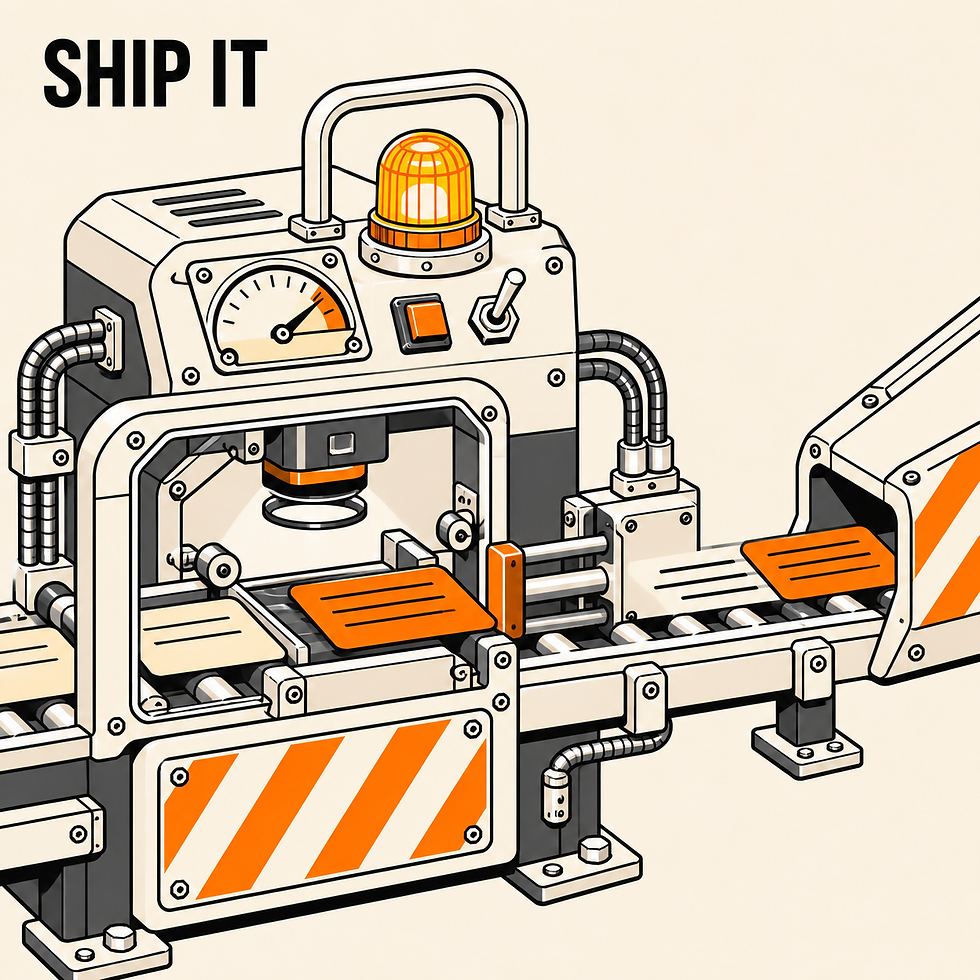
An enterprise AI pilot becomes deployable only after the team defines which outputs can reach customers and which require escalation or review.
A practical output policy structure has three tiers:
Auto-ship (low risk): Factual, low-impact, easily verifiable. Shipment tracking, inventory status, simple FAQ responses, typical account status questions.
Human-in-the-loop review (medium risk): Disputes, ambiguous eligibility, refunds, internal policy advice. Anything with nontrivial ambiguity or customer financial dependence. AI detects three times more fraudulent transactions for Mastercard, but flagged fraud cases still route to human review for final determination.
Expert-in-the-loop review (high risk): Medical advice, legal interpretations across jurisdictions, automotive safety determinations, insurance disputes with liability exposure, cross-border tax scenarios.
Criteria for tier assignment:
Dollar value at stake
Safety or legal exposure
Novelty of the input
Model confidence score
Data completeness
Domain sensitivity
These policies must be encoded directly in the AI platform and agent orchestration layer, not just written in governance documents. Human-in-the-loop integration is essential for high-stakes AI decision-making. Beginning AI deployment with low-risk use cases can yield measurable success and build organizational confidence before expanding to higher tiers.
Data Access, RAG, and Fine-Tuning: Getting Context Without Losing Control

Modern enterprise AI deployment relies on retrieval-augmented generation (RAG) to ground outputs in current contracts, policies, manuals, and customer history. Data governance is crucial for the deployment of AI solutions, and data quality is critical for successful AI deployment at every stage.
Data access rules should map to existing RBAC and access management policies. The AI agent only sees what a given role is allowed to see, and sensitive data is
masked or excluded. Compliance frameworks like GDPR, HIPAA, or CCPA guide data governance in AI. End-to-end encryption is important for AI data security during transit and at rest. Organizations need to adhere to evolving laws regarding data privacy and transparency when deploying AI.
When to use RAG vs. fine-tuning:
RAG: Fast-changing procedural content, knowledge bases, policy manuals, inventory data. Allows retrieval of fresh text without retraining.
Fine-tuning: Domain language, brand tone, recurrent patterns. Useful for shaping how foundation models respond, but risks embedding outdated rules if not maintained.
Integrating AI with CRM, ERP, policy systems, and case management increases accuracy but also increases the need for scoped permissions, audit logs, and data minimization. Data preparation and robust data management practices determine whether RAG pipelines return relevant, current documents or stale fragments.
Pearl connects to enterprise content and data sources in governed ways, then routes higher-risk, context-heavy questions through experts who can see the full picture where policy allows. Data readiness is not a one-time gate; it is a continuous operational requirement.
Staged Enterprise AI Deployment: From Shadow Testing to Monitored Scale
A concrete staged AI deployment strategy has four phases:
Shadow mode: AI runs alongside human agents, making silent predictions or drafts. Teams compare AI outcomes with human decisions without exposing answers to customers. This phase reveals model performance gaps before they reach anyone.
Limited exposure: Specific segments receive AI-assisted responses under strict policies. A single geography, logged-in customers with low-risk requests, or internal users only. Existing workflows stay intact as a fallback.
Controlled expansion: Expand use cases and segments only when predefined KPIs hold steady: answer correctness, escalation rate, customer satisfaction, cost per case. Escalation workflows must perform as expected under load.
Broad rollout with continuous monitoring: Full deployment across enterprise scale with active drift detection, feedback loops, and ongoing evaluation.
Proper training ensures employees can trust and effectively use AI tools during each phase. Comprehensive training programs enhance employee interaction with AI tools, especially for frontline support teams who must know when and how to override AI recommendations.
Instrumentation needs at every phase: log every prompt, data source, tool call, escalation decision, expert intervention, and final answer. The average time from pilot start to first production deployment is roughly 8 months for engineering AI initiatives. Successful pilots decide within 3.8 months on go/no-go; stalled ones linger past 6 months without a decision.
Where Expert Review Belongs in High-Impact Workflows

Pearl's experts come from JustAnswer's existing network of credentialed professionals. JustAnswer's published process says experts must have recognized credentials or relevant specialty experience, and a third-party service verifies each expert's identity and at least one relevant credential. JustAnswer also uses customer ratings, peer review, quality monitoring, secret shoppers, and an advisory board.
Pearl has 20,000 qualified experts across 100+ categories and reaches 43M+ daily visitors. Pearl's expert network runs on JustAnswer's platform, giving enterprises access to proven expert workflows at scale. Pearl has been pioneering AI in professional services for over a decade.
Workflows that should route to qualified expert review: nuanced legal interpretations, complex automotive issues (warranty, safety, diagnostics), cross-border tax scenarios, health-related questions, and high-value disputes.
A concrete sequence: the AI agent gathers data from business systems, drafts a response, flags risk attributes (confidence score, domain, dollar value), and sends the package to an appropriate Pearl expert for verification or augmentation. The expert reviews the draft with full context, corrects or confirms, and the answer returns through the same AI platform.
Expert review does not remove the enterprise's compliance duties. It increases quality, contextual judgment, and documented rationale where AI alone would be unsafe. Implementing AI in large organizations requires a balance between innovation and governance, and expert review is how that balance operates at the customer edge.
AI Governance in the Runtime: Policies That Actually Execute
AI governance is not a document. It is a set of operational controls that run during every interaction: classification, allow/deny rules, redaction, routing, and logging. AI governance includes policies for model transparency and accountability.
Concrete runtime controls:
Automatic detection and masking of PII and PHI
Jurisdiction-aware policy selection (different rules for EU AI Act compliance vs. US state laws)
Rate limits for high-cost or high-risk AI capabilities
Exclusion zones for advice the AI must not give
Governance must apply consistently across all AI interfaces: chatbots, agentic workflows, APIs, and internal decision-support tools. AI models should be regularly audited for fairness, transparency, and accountability. AI deployment should emphasize ethical considerations to mitigate algorithmic bias. Governance frameworks are essential for managing AI risks and compliance, and use of recognized frameworks like the NIST AI Risk Management Framework aids in risk management.
Cross-functional ownership is required. Legal, risk, data science teams, product, and operations jointly define guardrails that engineering encodes into the AI platform. AI governance should involve cross-functional teams for risk management. Establishing a clear AI governance framework helps structure AI initiatives within organizations. For a deeper look at how verification and logging work in practice, see how enterprise AI platforms verify their answers.
Monitoring, Evaluation, and Feedback Loops for Production AI

Evaluation spans the full AI lifecycle: offline test sets before deployment, live A/B experiments after launch, and targeted stress tests on edge cases, safety topics, and rare workflows. Successful AI implementations require regular evaluation against defined business outcomes.
Quality signals to monitor in production:
Answer correctness and adherence to policy
Escalation rate and expert override rate
Customer satisfaction scores
Downstream corrections by human support teams
Market trends in query patterns and new edge cases
Pearl's hybrid AI plus expert workflows create structured feedback data. Experts label issues, suggest better reasoning, and flag gaps in internal documentation. This feedback loop drives concrete actions: prompt updates, tool configuration changes, new escalation rules, retraining cycles, and documentation improvements. To understand these techniques in depth, see how to improve AI accuracy with structured human feedback.
MLOps practices ensure scalability and monitoring of machine learning models. Continuous model retraining is necessary to maintain AI performance as customer behavior, business context, and regulations evolve. Managing AI costs involves tracking usage and optimizing spending across applications. Data scientists and data science teams must own the evaluation pipeline, not treat it as a one-time validation exercise. Unstructured data sources, sensor data streams, and enterprise software logs all feed into model performance tracking.
Integrating Pearl Into Your Enterprise AI Deployment
Pearl's role in the workflow is specific: AI agents handle intake and drafting based on enterprise data; Pearl routes higher-risk or ambiguous cases to experts from JustAnswer's network; verified answers return via the same AI platform.
Pearl can plug into existing AI technologies, including RAG pipelines, orchestration layers, and CX front ends, through APIs that respect enterprise authentication and logging. This integration supports enterprise environments demand for auditability and control without replacing the enterprise's own AI infrastructure.
Pearl supports AI governance directly. Every expert interaction is timestamped, associated with a case, and made available for internal audit, training, and quality review. This creates the evidentiary record that enterprise artificial intelligence deployments need for compliance requirements.
For ecommerce, Pearl has demonstrated an engaged-shopper conversion rate where 30% of shoppers who interacted with Pearl on a product page converted within seven days. This is a specific result, not a guaranteed outcome for every retailer. It reflects what happens when AI plus expert answers reach customers at the moment of decision rather than after the sale falls apart.
For examples of operating models that blend AI and experts at scale, see how leading companies are scaling human-in-the-loop AI. Repetitive tasks stay automated. High-stakes decisions get expert judgment. Business units retain control over their enterprise AI strategy.
Production-Readiness Checklist: Questions Every Enterprise AI Owner Should Answer
Before you deploy AI to customer-facing workflows, answer these:
Output policy:
Have we defined which outputs auto-ship, which escalate, and which are blocked entirely?
Are those tiers encoded in the AI platform, not just documented in a policy PDF?
Data:
Do we know exactly which business systems this workflow reads from, how fresh the data is, and what the data privacy obligations are for each field?
Does data access follow existing RBAC and data governance rules?
Governance:
Are runtime controls for policy enforcement, redaction, and jurisdiction already executing in the deployment?
Is there cross-functional ownership (legal, risk, product, data, operations)?
Escalation:
Which teams or expert networks handle exceptions, at what SLA, and how is that path tested under load?
Can we trace every escalation from input to expert response to final customer answer?
Monitoring:
Are we logging every prompt, data source, confidence score, escalation decision, and expert override?
Do we have defined thresholds that trigger review of model performance?
Pick one existing AI pilot. Define its customer-facing review policy this quarter. Map where Pearl's experts would sit in the workflow. That exercise will surface the actual blockers faster than building another proof of concept.
FAQ: Enterprise AI Deployment, Risk, and Human Review
How long does it usually take to move an AI pilot into production at enterprise scale?
Typical timelines in 2025 and 2026 run 3 to 6 months from successful pilot to limited production, then another 3 to 9 months for broader rollout once governance, integrations, and monitoring are in place. Factors that shorten timelines: early security and legal involvement, reusing existing AI platform components, and clear output policies agreed at design time. 84.8% of successful pilots had active executive sponsorship, compared to roughly 31% for failures. Skipping governance or staged rollout can appear faster but often produces longer delays from rework, incident response, and failed audits. Predictive maintenance and supply chain use cases tend to move faster because their data pipelines are often already instrumented.
Who should own enterprise AI deployment decisions: IT, data, or the business?
No single function can safely own deployment alone. The recommended model: business process owner for outcomes, IT or platform team for infrastructure and security, data leadership for data access and quality, and risk or legal for AI governance. Decisions about which answers can auto-ship require joint accountability. Consider forming an AI review council that approves production workflows, not just models, and sets escalation rules and monitoring requirements. This council should review each workflow's output policy before any customer exposure.
How should we think about legal and regulatory risk when deploying AI solutions?
Legal exposure comes from three areas: incorrect regulated advice (finance, health, law), mishandled sensitive data, and poor documentation of how decisions were made. Practical steps: involve legal early, classify use cases by regulatory risk, require human or expert review for high-risk outputs, and maintain detailed logs for each AI-affected interaction. Working with expert-in-the-loop solutions like Pearl does not remove regulatory duties but strengthens the evidentiary record and quality controls for critical decisions. Leveraging AI responsibly requires deliberate, documented compliance at every step.
How do we decide where to use internal staff vs. external experts in AI-assisted workflows?
Segment by domain expertise rarity, volume variability, and required independence. Internal teams handle high-volume, standardized issues. External experts handle rare, complex, or specialized questions. Pearl's expert network, drawn from JustAnswer's credentialed professionals, covers 100+ categories without forcing enterprises to hire full-time staff in every niche. Map your current bottlenecks: where internal teams already escalate to outside counsel, specialized consultants, or niche technicians. Those cases are candidates for AI plus expert workflows that deliver measurable value and operational efficiency.
What is a practical first step if our pilots are stuck in demo mode?
Select one stalled AI pilot and draft a one-page deployment brief covering: target workflow, data sources, output policy tiers, escalation paths, and monitoring metrics. Run a short shadow test using real but governed data, with Pearl plugged in as the expert review layer for predefined high-impact questions. This focused experiment often reveals the true blockers: policy ambiguity, missing integrations, unclear ownership. It works faster than building another proof of concept. To implement enterprise AI, start with action, not another demo.


Comments